"Vibe-coding" is transforming how we prototype, but it introduces a new risk: spaghetti code that no human wants to touch. The true skill in modern development isn't just prompting, it's ensuring the output is scalable, readable, and ready for a team.
From "Vibe-Coding" to Production: Solving the Handoff Gap
The Speed vs. Clarity Trade-off
We are currently in a golden era of software creation. Tools allowing us to "vibe-code" (iterating on apps in real-time using natural language) are exhilarating. However, they often create a significant bottleneck down the road: The Handoff.
When you ask an AI to fix a bug or build a feature, it prioritizes functionality. It rarely prioritizes readability. This leaves human developers (or your future self) staring at a wall of logic without context.
The Fix: The Guideline.md Strategy
I recently implemented a workflow that bridges the gap between AI speed and engineering standards. The solution lies in a dedicated root file I call Guidelines.md.
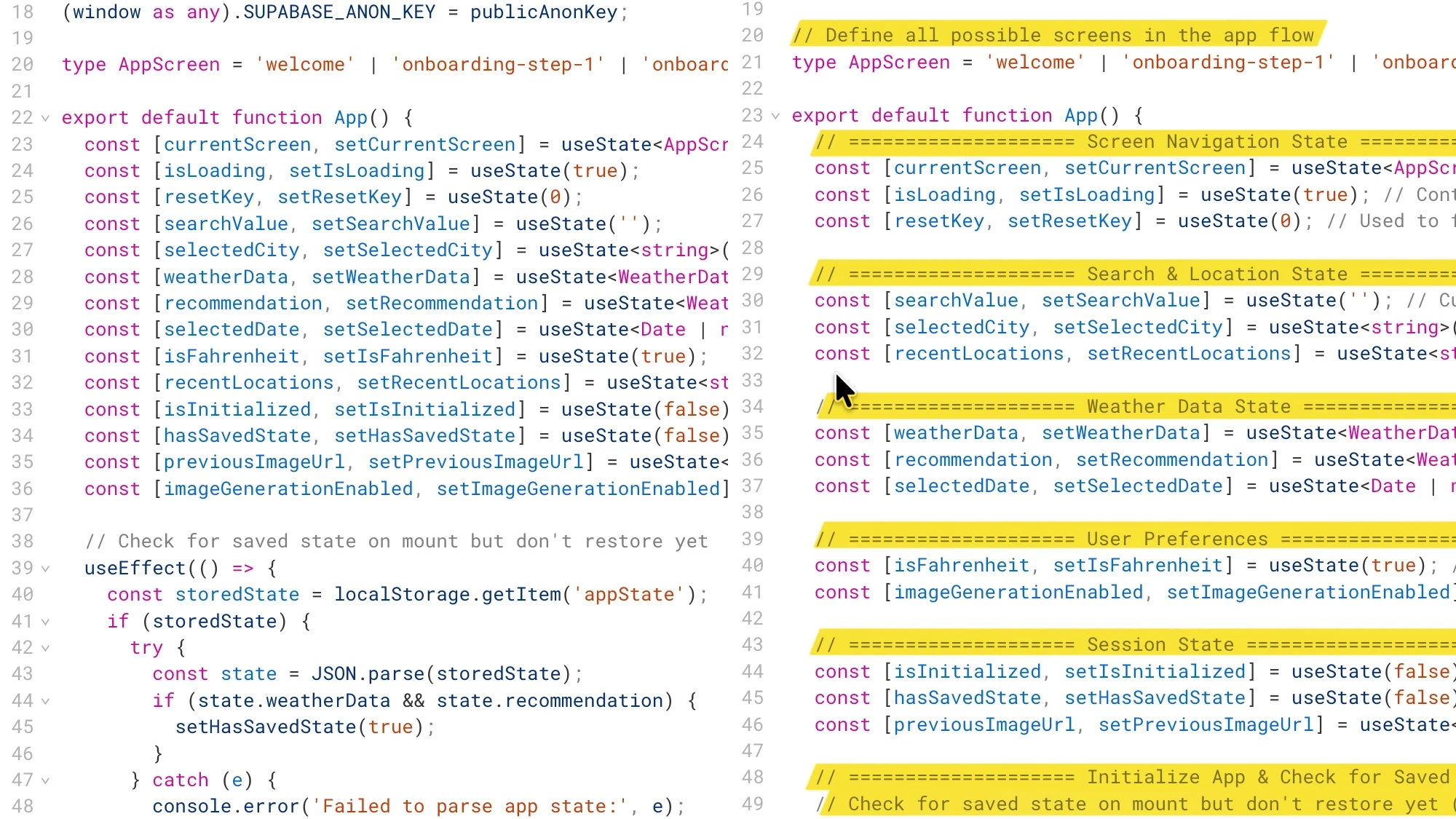
Instead of repeating instructions or hoping the AI writes clean code, I enforce it by anchoring the AI's context to this file. Inside Guidelines.md, I include one simple but non-negotiable rule:
"Keep the code documented with comments so it is easy for a developer to understand."
Why This Matters
By treating Guidelines.md as the project's constitution, every interaction with the AI produces code that effectively "documents itself."
This seemingly small change has a massive impact on the product lifecycle:
Smoother Handoffs: A developer taking over the repository doesn't have to reverse-engineer the logic. The context is baked into the comments.
Reduced Technical Debt: It prevents the codebase from becoming a "black box" that only the original prompter understands.
QA Efficiency: It makes it significantly easier to verify if the code is actually doing what it was intended to do.
The "Always Day One" Mindset
In the age of AI, building is easy. Engineering is still hard. Adopting a mindset where we treat AI-generated code with the same rigor as human-written code is what separates a prototype from a scalable product.
It’s not enough to just get it working. We have to make sure it keeps working when the team grows.